Enterprise SaaS Case Study
2025-2026
Brand Kit
Brand Kit is an AI-assisted content system that keeps AI-generated content on-brand. Organizations define their voice, standards, and knowledge once, then apply them consistently everywhere content gets created.
Overview
Making AI-generated content sound like your brand
I designed the brand rules configuration and knowledge base experiences for Brand Kit, an AI-assisted content system that helps organizations scale content production without losing what makes their brand sound like them. The underlying recommendation engine and AI model work sat with engineering; my part was the configuration flows, the information architecture behind them, and how a team actually works through setting one up.
Why this needed to be AI, not a style guide
A static style guide or a PDF of brand guidelines only works if someone remembers to open it. It can't evaluate a submitted image against a color palette, catch a Voice Profile drifting across hundreds of pieces of content, or apply a Policy Guardrail the moment content gets created. AI makes these rules enforceable at the point of creation. That's the gap a static document can't close, and it's the premise the rest of this system is built on.

Problem
AI content that didn't sound like anyone's brand
Generic AI output was the real cost center — not lack of AI capability. Organizations adopting AI-assisted content tools ran into the same wall: outputs that were fluent but interchangeable, with no memory of a brand's linguistic identity, writing standards, or context from one piece of content to the next. Every writer and editor was left re-explaining tone and guidelines by hand, every time.
Example
It's the same problem as hiring a new freelance writer for every single piece of content. Each one might be talented, but they're starting from zero, with no memory of the house style from the piece written an hour earlier.
Working the problem end to end
Before any screen got designed, this went through a full problem-solving pass: who it's actually for, what has to hold up under real conditions, which directions were considered and ruled out, the decision itself, and how it reaches a user in practice.


Research
What "on-brand" actually requires

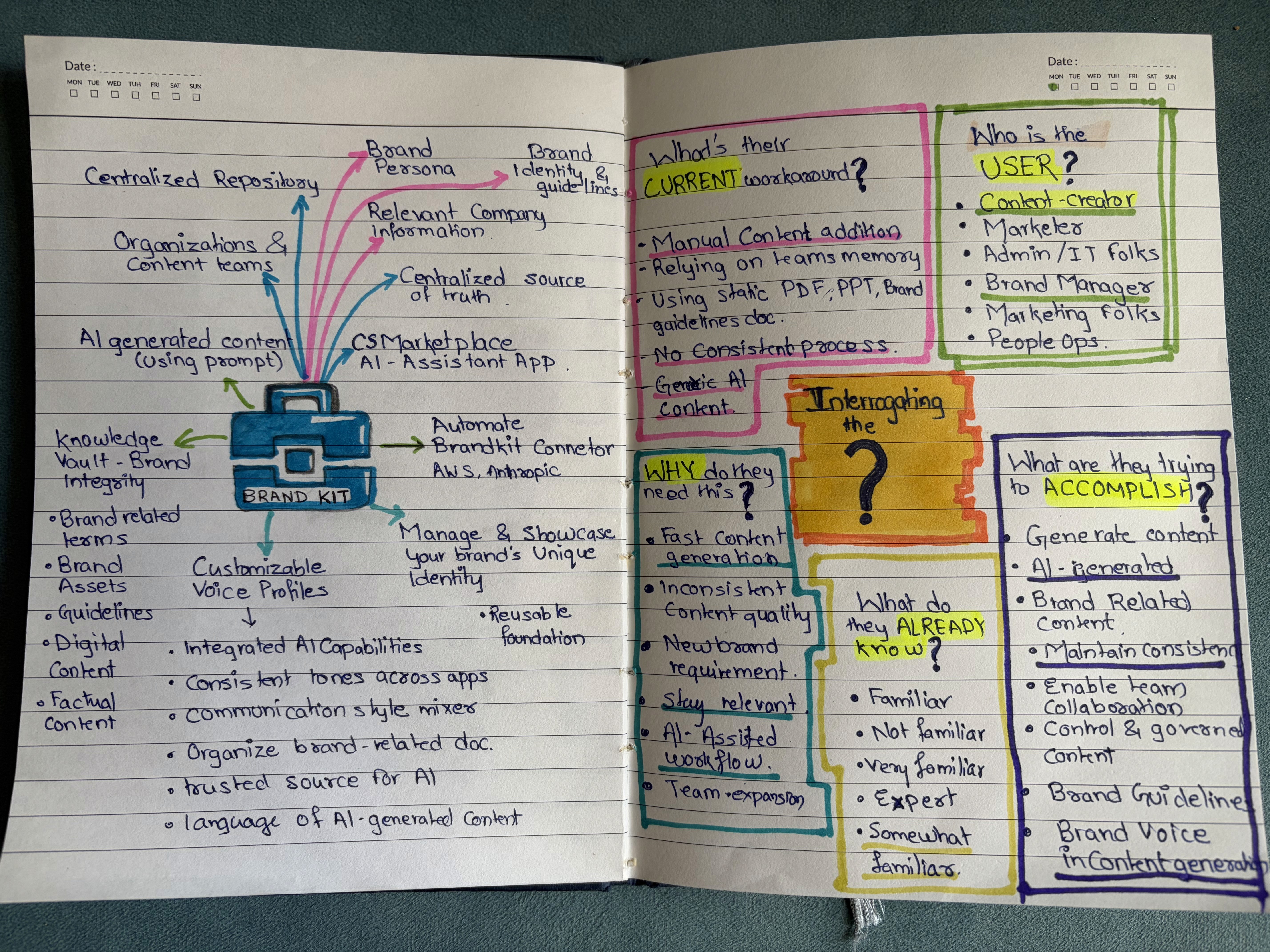
"Findings from early research, sorted into the three problems that shaped Brand Kit's direction."
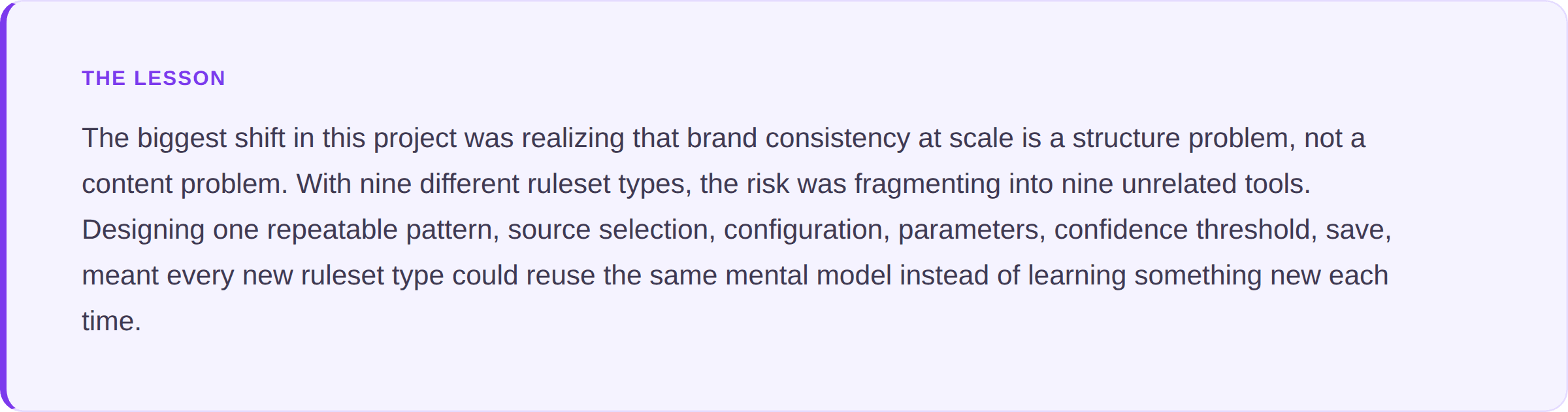
Before designing the configuration flows, I mapped out what an organization actually needs to define for AI to produce consistent, on-brand output. It broke down into nine distinct ruleset types, each governing a different dimension of brand and product standards.
0-1 Product
This was a net-new system, built from scratch. There was no existing product to compare against, so the research below reflects how the nine-ruleset model came together, not a redesign of something that already existed.
How the nine-ruleset model came together
Brand Kit didn't start as nine rulesets. It started as one: Voice Profiles, covering tone and structure and nothing else. That scope came up in an early conversation with the PM. Talking it through surfaced the gap: there was no separation by content type, so images, code standards, and compliance rules had nowhere to live except inside a model built only for voice.
"Right now Brand Kit is just voice profiles. Tone, structure, that's it. I don't think that's enough."
Nicolas
PM
From there, the scope expanded quickly. Once "voice" opened into "any brand or product standard," it was easy to keep adding categories. Nine felt comprehensive, but it hadn't been validated against anything yet.
The second turning point came later, in a PRD conversation with engineering about what an MVP could realistically ship. We couldn't build all nine ruleset types at once, and we didn't want every new type to require redesigning the flow from scratch. That constraint produced the shared five-step pattern: source selection, configuration, parameters, confidence threshold, save. Build a few ruleset types first, add the rest later, and reuse the same shell each time.

Revisiting the nine: do they all solve the same problem?
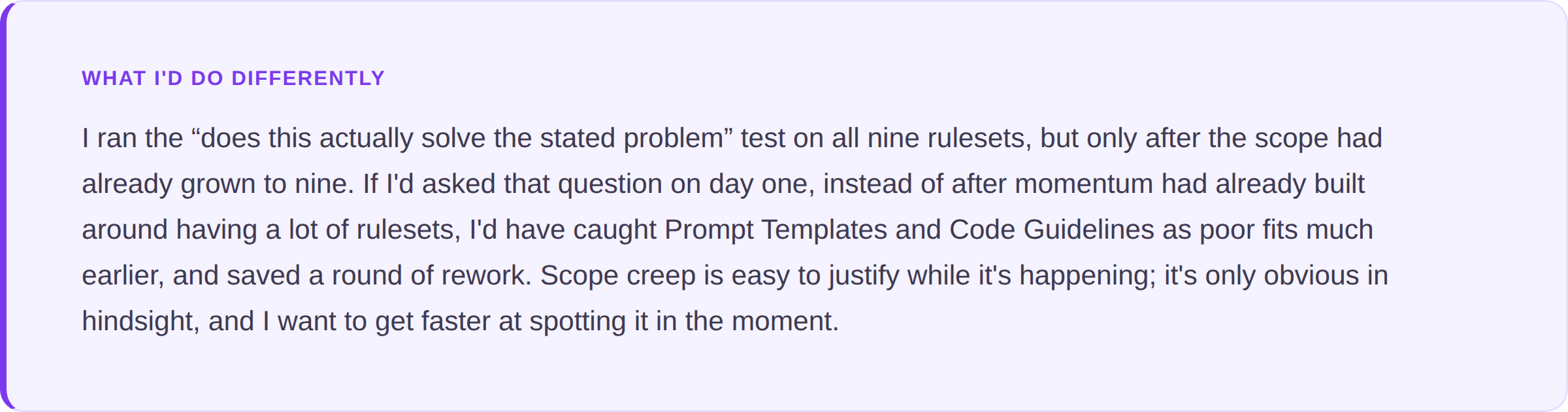
Before deciding which few to build first, I went back to the Problem statement: AI content that doesn't sound like the brand. Checking each of the nine against one test, whether it governs something no other rule does and whether AI can actually reference it while generating content, not all of them held up.
Kept — five rulesets
Voice Profiles, Visual Guidelines, Image Profiles, Agent Alignment Profiles, and Policy Guardrails. Each one controls something the other four can't.
That reframed the MVP decision. The five kept types became the scope, justified by the problem statement itself, rather than a handful picked to fit a timeline. Fewer, non-overlapping rulesets build a stronger source of truth than nine that blur together.

From conversations to decisions: real project moments behind Brand Rules, not synthesized findings.
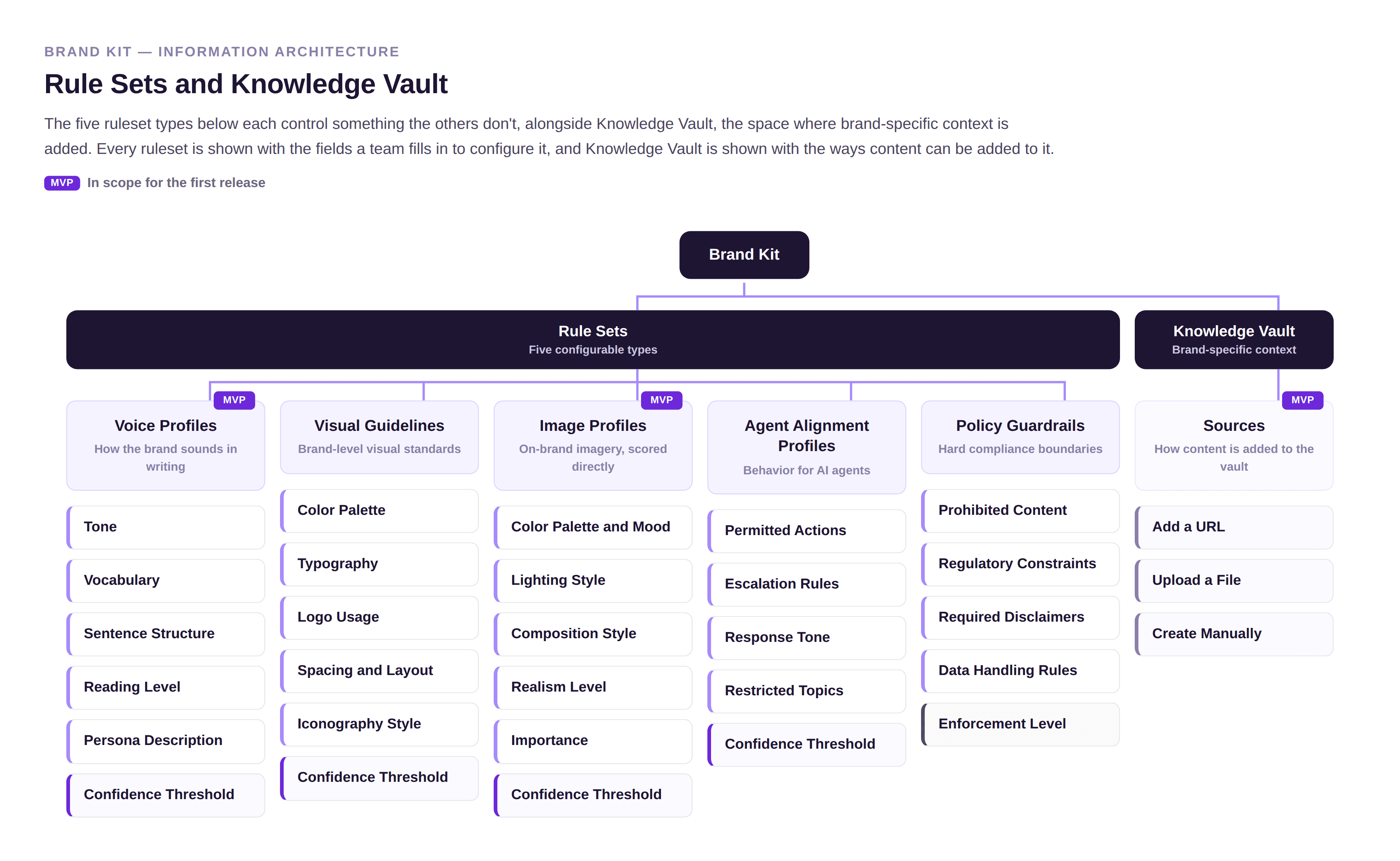
Voice Profiles and Image Profiles shipped first, not because they mattered more than the other three, but because of what was actually possible: a small team and a limited timeline meant getting something real in front of users mattered more than launching all five at once. Between the two, they're also the rules touched on nearly every entry someone creates, so they'd surface the most about whether the pattern worked before committing engineering time to the rest.

Ideation
Designing two connected systems
I explored how brand rules and knowledge base setup could work as one coherent system while still respecting how differently each ruleset behaves:
Brand Rules
A unified ruleset system spanning the five types that survived scope review, each configurable on its own terms and discoverable through one consistent pattern.
Knowledge Base Setup
A managed space for brand-specific knowledge that gives AI real context instead of generic filler.
The constraint running through both: define once, apply everywhere, without forcing every ruleset type into an identical shape.
Getting from zero Brand Kits to one
Both systems above assume a Brand Kit already exists to configure them inside of. That starting point isn't a separate pillar of the product; it's the shared entry point Brand Rules and Knowledge Base Setup are both configured within. Here's what that looks like.
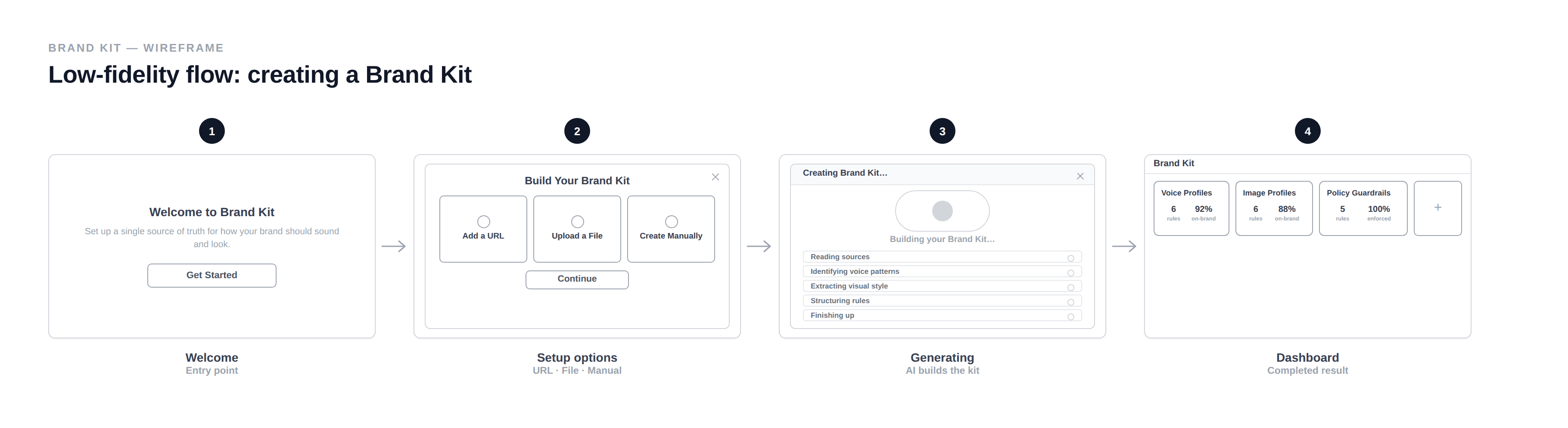
Brand kit - Setting up a Brand Kit — the entry point users hit before any rules exist.
Goal - No dead-end at zero. A team with nothing configured yet should reach a usable Brand Kit without needing a manual.
A tradeoff I pushed back on: where Playground lives
The first version placed Playground, where you test an image against a profile's configuration, directly below the Configuration section on the same page. In practice, it broke: editing a parameter and scrolling down to test it still evaluated against the last saved state, not the change just made. The tool meant to build trust in the system was quietly undermining it.
I pushed for moving Playground out of the linear page flow entirely, into a collapsed icon in the right-hand menu that stays pinned open alongside Configuration. The fix wasn't patching the sync bug; it was recognizing that a "test as you go" tool needs to be persistent rather than a scrollable section. Side by side, a parameter change and its score are visible in the same moment, which the original layout couldn't deliver even with the sync issue resolved.


Brand Rules (Image Profiles) — Two ways to define a ruleset — by hand or by AI — plus how it gets tested before going live.
Goal -A working profile without guesswork, whether someone builds it by hand or lets AI draft it first.

Knowledge Vault — Centralizing brand knowledge — from empty state to AI-populated vault.
Goal - AI stops inventing details it doesn't have, because the real ones are a click away instead of missing entirely.
Designs
A single source of truth for brand standards
This was built from scratch, with nothing before it to compare against, so there's no before/after here the way there would be for a redesign. What follows is what got built, and what it's meant to change.
Brand Rules
A structured ruleset system spanning five types after scope review: Voice Profiles, Visual Guidelines, Image Profiles, Agent Alignment Profiles, and Policy Guardrails, each controlling something the others don't. Design Themes was folded into Visual Guidelines, Feature Requests was moved out of Rulesets since it wasn't governing anything AI generated, Prompt Templates works better as a shared library since there was nothing to score, and Code Guidelines was cut since code isn't brand content.
One friction point surfaced during testing. Letting users name a custom parameter didn't fully decouple it from the system underneath: a parameter named "Lighting Style" was still silently scoring against "Color Palette & Mood," because every custom parameter had to map to one of six existing types. The fix made custom parameters genuinely independent, with their own name, description, and scoring logic, rather than a label wrapped around a fixed category.
GoalSetup time under 10 minutes for a first ruleset, with the recommended defaults doing most of the work.
Knowledge Base Setup
An interface for adding and managing brand-specific knowledge, giving AI the context it needs to produce content that's relevant and personalized, not generic.
GoalFewer edits after generation because the AI already knows brand-specific facts, not just brand-specific tone.
Future Scope
What this system doesn't answer yet
Proposed — not in current build. Both items below are open questions this project surfaced, not shipped features.

Two open questions from designing Brand Rules, not yet built: versioning, so edits don't silently break already-scored content — and Role Based Access Control (RBAC), so ruleset ownership is enforced, not just assumed.